Art: To Buy or Not To Buy Limited Editions
- Oct 17, 2015
- 6 min read
Brought to my attention most recently was the question surrounding the Limited Edition art print. I, by no means, am an art expert, nor even a critic per se. I'm just a mere observer / economically quarantined collector, who dabbles a bit in painting and photography. I sometimes visit art exhibits and may remember a few famous names and works, but I'd rather not dare pretend to be the know-it-all at the next swanky dinner soiree. I fared well in high school art and had a great interest in pursuing art as a profession years ago... before the internet and the high demand for graphic designers. In yesteryear, art for the masses was an afterthought and being an artist as a career was a fool's pursuit, so I was told. Today things are very different with the opportunities presented by online galleries, marketplaces, and questionable competitions. An artist, one can become.
So when you're out in your local trendy gallery, what makes you pull out your card [or checkbook] to chuck down several $100s to $1000s for a piece you're admiring? There are many factors to consider. Some would liken it to playing the stock market with a come hither twist. Others might say, follow your heart and you'll always win. For me, a blend of both philosophies usually comes into play. For investment ie. resell purposes, I usually will research an artist and similar artists or pieces online before purchasing artwork of interest. On the other hand, when a piece really moves my spirit, stirring strong emotion, preferably happiness and joy, the resale value doesn't weigh as heavily.
Now perception comes into play with art valuation, just as it does in every darn thing we do in this world. Perception is part smoke and mirrors and many times less substance. A thought runs through my head, comparing the present political bantering, which I avoid like the plague, to valuation. There's even a stock market weighing the minor successes and failures of political candidates...and perception pricing in some circles can be just like that. Some wealthy patron takes some new "talent" under their wing and wahlah "a star is born". You may stare dumbfounded at a canvas with literally nothing on it and wonder wtf is going on. To each his/her own. If there is one thing I can assuredly tell you about valuation and sales concerning artwork and any one-of-a-kind items, beauty is always in the eye of the beholder. What speaks to your heart, may not speak to your friend-lover-family's heart. If you are buying for you, then buy it for you. If you are buying as an investment, do your homework, but understand there are no guarantees. I have gambled and loss many times while optimistically estimating resale price. Of course, the more exclusive and rare an items is, the more coveted it can be.
Artists themselves choose the selling situation that's best for their goals, ie. wallet and their 'personality'. It's a continuing question: whether they want to offer open prints or limited editions. The general fact is that a collector would first prefer an original piece, then a limited edition as second choice. Open editions can offer a chance for more people to enjoy the print at a more affordable price point. An artist may make more money selling a lot of 'economically viable' ie.cheaper prints of their pieces, than waiting on a few big money sales.
As an artist myself, I pick and choose which prints I want to use where and how I might offer them. Recently I've began to enjoy applying original art to clothing and decor so that it can be enjoyed on other mediums. This could decrease value if manufactured en masse, but since I'm very small time and plan on limited numbers of clothing and decor, hopefully there'll be appreciation, not depreciation. LOL. I maintain that actual art prints, should be limited editions. When I buy art, I prefer originals and limited editions, but if something is really cool, but a mass production, I might still pick it up, keeping in line with pricing.
Here are a few examples in different formats of ways that limited editions may be presented:
1) Frank Sinatra and Quincy Jones print "A Man and His Music" with Certificate of Authenticity and Numbered on Front
2) Francisco Zuniga print is signed and numbered by artist in pencil
Mary Lou Goertzen print has a printed number on back "#040" indicating it's a limited edition instead of hand signed in pencil by artist, it was offered by Disney World in 1970 and still has the original price sticker of $6.


1) Frank Sinatra and Quincy Jones Limited Edition Print "A Man and His Music" 40/275 *


2) Francisco Zuniga Signed Limited Edition Print 15/16 *


3) Mary Lou Goertzen Limited Edition Print #040 *
Below are examples of two [2] distinct prints by the same artist - John Powell. One is an artist signed limited edition, the other is not, and for that reason their prices are vastly different:
4) The first, "Garden Party" is a limited edition serigraph [print] It is clearly signed and numbered by the artist and it's presently priced at $1595, marked down from $2995 buy a dealer on Chairish.com. There are other limited editions by Powell starting around $500.
5) The second example is a Powell piece I have in my collection [lol, I wish I had a limited edition of this one]. It is suitably titled "Still Life On the Veranda", and is a gallery print, which may be produced in a finite number, but is not a qualified limited edition - no number or signature - and the price is around $200 give or take, given it is framed in glass. So without the glass, hummm. Anyway, regardless of "value", it is gorgeous.


4) John Powell's "Garden Party" Limited Edition Print 29/30 *

5) John Powell's "Still Life On the Veranda" print offered by De Ville Gallleries *
The last example is of a present day modern format of certificate of authenticity and signed limited edition. Many artists today have the option to print on demand, which is initially less expensive and minimizes storage requirements. An artist can display artwork for sale, in it's original form - whether it's a painting, photograph, or what have you, then have a high quality print made as needed. Here is one of my own photography prints, recently printed on demand: "Hallways" Ltd Edition 2/10


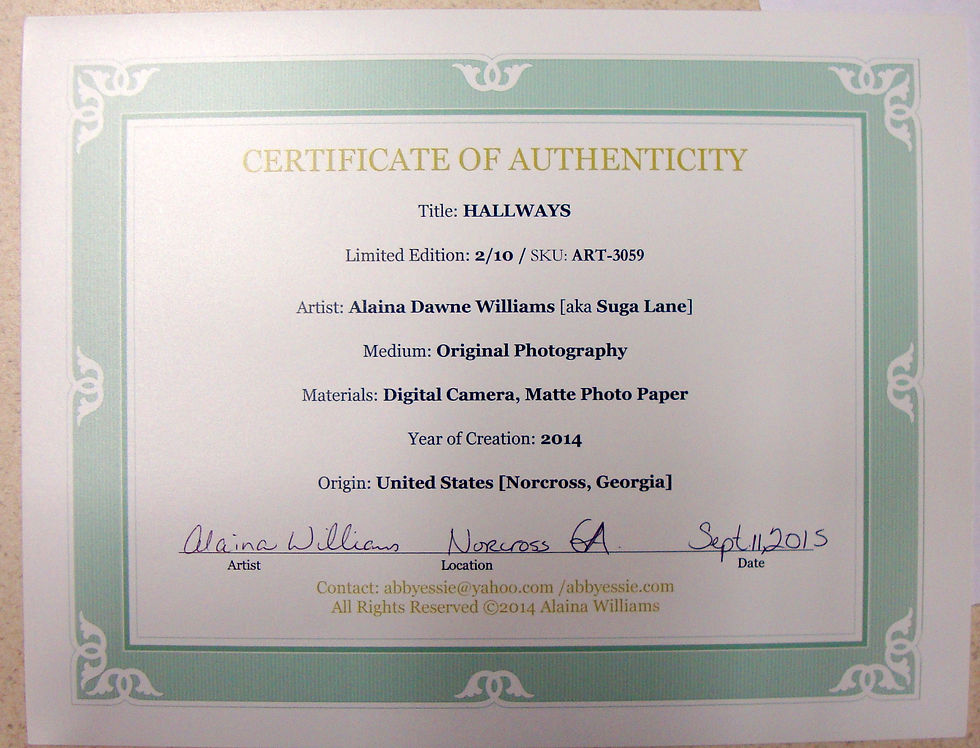
6) Alaina Williams "Hallways" Limited Edition Photographic Print 2/10 *
The main thing about limited editions is there has to be something on the piece clearly indicating it is exactly that. Usually a hand-written fraction or as in the Mary Lou a printed number. Some artwork may be referenced in some historical book with data linking and authenticating the piece in some other manner. Some pieces clearly state "Limited Edition" or "Ltd Ed." and have a number. Certificates of Authenticity are the icing on the cake.
* 1)Limited edition giclee -"A Man and His Music," Frank Sinatra and Quincy Jones,1964. Number 40 of 275. Stamped with Hulton Archive seal in bottom left corner. Certificate of authenticity on the back. Beautifully matted and framed. Frank Sinatra Enterprises Archive. (Source: Provisions Home and Garden via Charish.com)
2) A fine art lithograph by internationally acclaimed sculptor and printmaker, Francisco Zuniga. The lithograph is signed and numbered in the lower right 15/16. (Source: Antique Canvas via Chairish.com)
3) Vintage Mary Lou Goertzen pink floral signed limited edition Lithograph #040. This print still has its original Vintage Disney tag circa 1970 for $6. (Source AbbyEssie.com)
4) Rare John Powell "Garden Party" limited edition artist proof with only 30 made! This signed and numbered serigraph is number 29/30. Created in 1989 with 125 vibrant colors. (Source Erin Lane Estate via Chairish.com)
5) John Powell “Still Life On The Veranda" Poster Print - De Ville Galleries Los Angeles (Source: Abbyessie.com)
About the Author: Alaina Williams aka "Suga Lane" is a mompreneur, painter, writer, singer, who loves to shop for one-of-a-kind treasures. Her book "Make Money Re-Selling Clothing & Decor Online" is slated for a November 2015 release.


Comments